
NAME
i.sam.opencl - Segments a 3-band imagery group with the Segment Anything Model (SAM) on an OpenCL device and writes the segments as vector areas.KEYWORDS
imagery, segmentation, object recognition, deep learning, GPU, OpenCL, vectorizationSYNOPSIS
Flags:
- -n
- Do not download a missing checkpoint into the weights folder
- --overwrite
- Allow output files to overwrite existing files
- --help
- Print usage summary
- --verbose
- Verbose module output
- --quiet
- Quiet module output
- --ui
- Force launching GUI dialog
Parameters:
- group=name [required]
- Name of input imagery group with exactly 3 raster maps (R, G, B)
- subgroup=name
- Name of subgroup with exactly 3 raster maps to use instead of the whole group
- checkpoint=name
- SAM checkpoint file
- Original PyTorch checkpoint, e.g. sam_vit_h_4b8939.pth (vit_h, vit_l or vit_b)
- weights_dir=name
- Folder of SAM checkpoints
- Folder of .pth checkpoints named with vit_h, vit_l or vit_b, where missing ones are downloaded; default: $SAM_MODELS_DIR/sam1, else ~/models/sam/sam1
- model=string
- SAM model to use from the weights folder
- Default: the best one present (vit_h, then vit_l, then vit_b), or vit_h if there is none
- Options: vit_h, vit_l, vit_b
- vit_h: ViT-H, 2.4 GiB, best quality
- vit_l: ViT-L, 1.2 GiB
- vit_b: ViT-B, 358 MiB, fastest
- output=name [required]
- Name for output vector map of segments
- raster=name
- Name for optional output raster map of segment categories
- percentile=lower,upper
- Percentiles of each band stretched to the 0-255 range fed to SAM
- Options: 0-100
- Default: 2,98
- points_per_side=integer
- Number of prompt points along each side of a crop
- Options: 1-128
- Default: 32
- iou_threshold=float
- Minimum mask quality predicted by the model
- Options: 0-1
- Default: 0.88
- stability_threshold=float
- Minimum mask stability under a shift of the logit cutoff
- Options: 0-1
- Default: 0.95
- stability_offset=float
- Logit cutoff shift used to compute the stability score
- Default: 1.0
- nms_threshold=float
- Box IoU above which duplicate masks are suppressed
- Options: 0-1
- Default: 0.7
- crop_layers=integer
- Number of zoomed-in crop layers (layer n has 4^n crops)
- Options: 0-3
- Default: 0
- crop_points_downscale=integer
- Divide points_per_side by this factor in each crop layer
- Options: 1-8
- Default: 1
- minsize=integer
- Minimum segment size in cells
- Smaller holes and islands are removed from masks and smaller pieces merged into their neighbours
- Options: 0-
- Default: 100
- maxsize=integer
- Maximum mask size in cells
- Larger masks, typically a background mask spanning the whole scene, are discarded
- Options: 1-
- overlap=string
- Mask kept where masks overlap
- Options: small, large, score
- Default: small
- small: smallest mask (finest partition)
- large: largest mask (coarsest partition)
- score: mask with the highest predicted IoU
- simplify=float
- Boundary simplification tolerance in map units
- Douglas-Peucker tolerance; default is one cell, 0 keeps the raster staircase
- Options: 0-
- tile_size=integer
- Side of the tiles, in cells, a larger region is split into
- Options: 64-
- Default: 1024
- tile_overlap=integer
- Overlap between tiles in cells
- Options: 0-
- Default: 256
- batch=integer
- Number of point prompts decoded at once on the device
- Options: 1-256
- Default: 32
- device=string
- OpenCL device type
- Options: auto, gpu, cpu
- Default: auto
- platform=string
- Use only OpenCL platforms whose name contains this text
- profile=string
- Device profile choosing buffers and kernels
- Options: auto, cpu, igpu, dgpu, egpu
- Default: auto
- auto: Detect from the device
- cpu: Host-memory device (PoCL): mapped buffers, CPU kernels
- igpu: GPU sharing host memory: mapped transfers
- dgpu: GPU with its own memory on internal PCIe
- egpu: GPU behind a slow link (Thunderbolt, remote): pinned staging
- precision=string
- Storage type of the weight matrices
- Options: fp32, fp16
- Default: fp32
- fp32: Single precision
- fp16: Half precision storage, single precision arithmetic
Table of contents
DESCRIPTION
i.sam.opencl segments a 3-band imagery group with the Segment Anything Model (SAM) and writes the segments as a clean vector area map. The whole network, image encoder and mask decoder, runs on an OpenCL device (GPU or CPU), with weights read directly from the original PyTorch checkpoint file: neither Python nor PyTorch is needed at run time.The module implements SAM's automatic mask generation: the model is prompted with a regular grid of points, and the masks it returns are kept according to their predicted quality and stability, de-duplicated and cleaned. The overlapping masks are then turned into a non-overlapping, topologically clean vector map with one attribute row per segment.
The group (or its subgroup) must contain exactly three raster maps, which are used as the red, green and blue channels in the order they are listed in the group (see i.group). Each band is stretched linearly between its lower and upper percentile to the 0-255 range SAM was trained on. Cells that are NULL in any band are not segmented. Processing is done in the current computational region.
Checkpoint
The checkpoint is one of the original model files published with SAM; the model variant is detected from the tensor shapes:- ViT-H: sam_vit_h_4b8939.pth (2.4 GiB, best quality),
- ViT-L: sam_vit_l_0b3195.pth (1.2 GiB),
- ViT-B: sam_vit_b_01ec64.pth (358 MiB, fastest).
The weights are too large to be installed with the module. Without a
checkpoint file, the module looks for one in the weights folder:
weights_dir, by default the central folder
$SAM_MODELS_DIR/sam1, or ~/models/sam/sam1 when
the environment variable SAM_MODELS_DIR is not set. If the
model is not there, its checkpoint is downloaded into that folder
(created if needed) on first use and reused afterwards: the model chosen
with model, or ViT-H when the folder holds no checkpoint at all.
The download is checked against the published size, resumes where an
interrupted one stopped, and waits for another run downloading the same
file. The -n flag forbids downloading: a missing checkpoint is
then an error.
A checkpoint is recognised in the weights folder by
vit_h, vit_l or vit_b in its
.pth file name, so renamed copies such as
sam_vit_h_checkpoint.pth are found too. The best model present
is used (ViT-H, then ViT-L, then ViT-B), or the one chosen with
model; the module checks that the file really holds that model. If a
folder holds several files of the chosen model, the first in
alphabetical order is used, with a warning.
Mask generation
The region is processed in square crops. A region no larger than tile_size cells is one crop, a larger region is split into tiles of tile_size cells overlapping by tile_overlap cells. With crop_layers greater than 0, each tile is additionally segmented in zoomed-in sub-crops (4 in layer 1, 16 in layer 2, ...), prompted with points_per_side divided by crop_points_downscale per layer.Each crop is resized so that its longest side is 1024 pixels and passed through the image encoder. The mask decoder is then prompted with a grid of points_per_side x points_per_side points, batch prompts at a time, returning three candidate masks per point. A mask is kept if its predicted IoU exceeds iou_threshold and its stability score (the IoU of the mask thresholded at plus and minus stability_offset) is at least stability_threshold. Duplicates whose bounding boxes overlap by more than nms_threshold (IoU) are suppressed, keeping the best one. Masks touching an inner tile or crop edge are discarded, since the neighbouring tile sees them whole. Holes and islands smaller than minsize cells are finally removed from each mask.
These steps and their defaults are those of the reference
SamAutomaticMaskGenerator; on identical input,
i.sam.opencl returns the same masks.
Vectorization and cleaning
SAM masks overlap: a field and the parcels inside it can both be masks. The overlap rule chooses which mask a cell belongs to: the smallest covering mask (small, finest partition, the default), the largest (large) or the one with the highest predicted IoU (score). Masks larger than maxsize cells are discarded first; this is the way to drop the single mask SAM often returns for the whole background of a scene.The resulting label raster is cleaned: every connected piece smaller than minsize cells, including small unsegmented gaps, is merged into the neighbouring piece it shares the longest border with. Boundaries are traced along cell edges into shared topological boundaries, simplified with the Douglas-Peucker algorithm using the simplify tolerance (one cell by default; 0 keeps the raster staircase), and the topology is cleaned (boundaries broken at intersections, duplicates removed, pseudo-nodes merged, slivers smaller than one cell removed). Each segment gets one centroid, placed at the cell farthest from its border.
Areas without a centroid are gaps that no mask covers. The optional raster output holds the segment categories of the cleaned label raster before simplification.
Attribute table
| Column | Description |
|---|---|
| cat | Segment category |
| mask | Number of the SAM mask the segment comes from |
| predicted_iou | Mask quality predicted by SAM |
| stability | Stability score of the mask |
| cells | Segment size in cells |
| area | Area of the simplified polygon in square map units |
A mask split into several pieces by overlapping masks yields several segments with the same mask number.
NOTES
OpenCL device
With device=auto, the first GPU is used, else the first CPU device. When several OpenCL platforms expose the same device (for example Mesa's Clover and rusticl drivers for AMD GPUs), the first platform on which the kernels compile is used; platform restricts the choice to platforms whose name contains the given text. Mesa's rusticl only exposes a GPU when enabled in the environment, e.g.RUSTICL_ENABLE=radeonsi. A CPU OpenCL implementation such as
PoCL gives the same result but is about two orders of magnitude slower.
The ViT-H weights take 2.4 GiB of device memory and the work buffers about 1.3 GiB with the default batch of 32 prompts; a smaller batch reduces memory use. Buffers are kept below the device's maximum allocation size.
Device profile and precision
The profile chooses how buffers are allocated and which matrix product kernels run, to suit the device:
- cpu: a device working in host memory, such as PoCL. Buffers are mapped instead of copied, and the matrix products use kernels without local memory that stream rows with 8-wide vector loads, which PoCL runs far better than the GPU kernels.
- igpu: a GPU sharing host memory (integrated graphics, APU). Transfers map the buffers instead of copying them; the driver places the buffers (on Intel, buffers allocated in host memory slowed the kernels by about 15 %).
- dgpu: a GPU with its own memory on internal PCI Express. Buffers live in device memory.
- egpu: a GPU behind a slow link, such as a Thunderbolt or USB4 enclosure. Buffers live in device memory and large transfers go through a pinned staging buffer. The weights stay on the device for the whole run.
With profile=auto the profile is detected: cpu for a CPU device, igpu for a GPU that reports unified memory, egpu for a GPU whose PCI function Linux marks as removable (when the driver reports its PCI address), dgpu otherwise. The chosen profile and the reason are printed. A profile can be forced to compare them; every profile gives the same results, only the speed differs.
precision=fp16 stores the weight matrices of the linear layers
(most of the model's memory) as IEEE half-precision numbers, read with
the core OpenCL vload_half functions, so no half-precision extension
is needed; the arithmetic stays in single precision. It halves their
memory and the bytes read by the matrix products, which matters on
devices limited by memory bandwidth (integrated GPUs, CPUs). Rounding
the weights to half precision changes the masks slightly; check the
result against precision=fp32 (the default) on a sample before
relying on it.
Performance
On an AMD Radeon Pro WX 7100 (Polaris, 16 GiB, Mesa rusticl), with the ViT-H model, loading the model takes 1-2 s, the image encoder 3.8 s per crop and the mask decoder 3.7 s per 1024 prompts (the default 32 x 32 grid). A single-crop region is thus segmented in about 8 s. The number of crops, and so the run time, grows with the region size divided by tile_size, and with crop_layers.Choosing the resolution
SAM sees every crop at 1024 x 1024 pixels. Objects should span at least ten or so pixels at that scale: set the region resolution and tile_size accordingly. A smaller tile_size zooms in (crops are upsampled to 1024 pixels), which finds smaller objects at the cost of more crops. For agricultural parcels in 2.5 to 10 m imagery, the defaults work well.Debugging aids
When the environment variableI_SAM_OPENCL_DUMP names a
directory, the 8-bit crops, the encoder inputs, the image embeddings and
the list of masks are written there. The script
tests/reference_compare.py in the source tree compares them
with the PyTorch reference implementation.
I_SAM_OPENCL_PROFILE=1 prints the time spent in each OpenCL
kernel. Each line gives the event time and the wall-clock time (some drivers, such as rusticl on Intel iris, report wrong event times), and for the matrix products the achieved GFLOP/s, which shows whether a kernel is limited by compute or by memory bandwidth. I_SAM_OPENCL_DOWNLOAD_URL replaces the download
location (https://dl.fbaipublicfiles.com/segment_anything),
for a local mirror.
EXAMPLES
Landsat scene (North Carolina sample dataset)
Segment a true-colour composite of Landsat 7 bands 3, 2 and 1, dropping the background mask (the region has 475 x 527 cells):
g.region raster=lsat7_2002_30 -p
i.group group=lsat_rgb input=lsat7_2002_30,lsat7_2002_20,lsat7_2002_10
i.sam.opencl group=lsat_rgb checkpoint=sam_vit_h_4b8939.pth \
    output=lsat_segments maxsize=50000
v.db.select lsat_segments | head
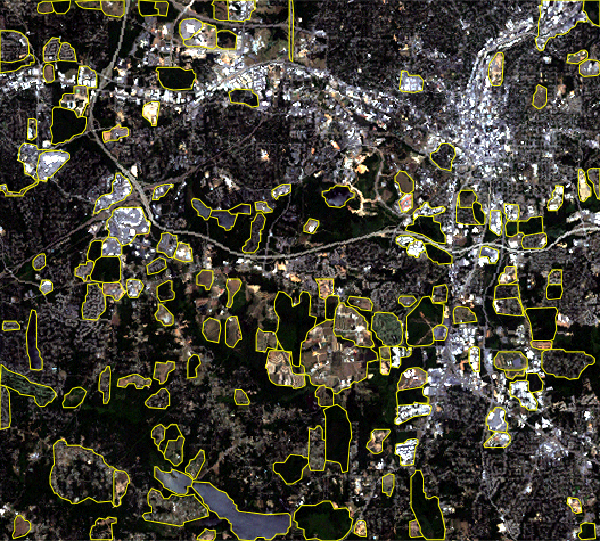
Segments of the Landsat 7 true-colour composite (yellow).
Weights folder
Use the fastest model for a quick look; it is downloaded into~/models/sam/sam1 the first time:
i.sam.opencl group=lsat_rgb model=vit_b output=lsat_quick maxsize=50000
Agricultural parcels
Delineate fields in a 2.5 m VNIR image with bands 1-3 grouped as RGB, keeping only segments of at least 0.1 ha (160 cells) and a label raster alongside the vector map:
i.group group=vnir_rgb input=vnir.1,vnir.2,vnir.3
g.region raster=vnir.1 -p
i.sam.opencl group=vnir_rgb checkpoint=sam_vit_h_4b8939.pth \
    output=fields raster=fields minsize=160
REFERENCES
Kirillov, A., Mintun, E., Ravi, N., Mao, H., Rolland, C., Gustafson, L., Xiao, T., Whitehead, S., Berg, A. C., Lo, W.-Y., Dollar, P., Girshick, R., 2023. Segment Anything. Proceedings of the IEEE/CVF International Conference on Computer Vision (ICCV), 4015-4026. arXiv:2304.02643SEE ALSO
i.group, i.segment, r.to.vect, v.clean, v.generalizeAUTHORS
Yann CheminSOURCE CODE
Available at: i.sam.opencl source code (history)
Accessed: Sunday Nov 15 10:57:14 2026
Main index | Imagery index | Topics index | Keywords index | Graphical index | Full index
© 2003-2026 GRASS Development Team, GRASS 8.5.1dev Reference Manual